On this holy day of Janmashtami 2026, I find myself reflecting on the deeper principles and teachings of Krishna, as revealed through the Bhagavad Gita and its place within the larger story of the Mahabharata.
I asked myself a simple but profound question:
Where did the thread of decisions begin that ultimately led to the deadly war of the Mahabharata—and to the moment when Krishna had to give us the wisdom of the Gita?
Did Bhishma place his father’s desire and personal happiness above his responsibility to the Kuru kingdom as its future king—treating his father’s happiness as sufficient reason to surrender a responsibility that was ultimately larger than himself?
Shantanu wanted to marry Satyavati.
But Satyavati’s father wanted her children to inherit the Kuru throne. Bhishma therefore gave up his claim to the throne—and then went even further, taking a lifelong vow of celibacy so that he could never have children who might challenge Satyavati’s descendants.
His vow remains one of the most extraordinary expressions of filial devotion in the epic.
But I wonder whether the Mahabharata is asking us to look beyond the nobility of an intention and examine the consequences that can unfold from even the most selfless of choices.
Could Bhishma’s decision be examined as a failure of dharmic discernment?
Can an act born of love, sacrifice and loyalty nevertheless create circumstances that later contribute to adharma?
What happened after Bhishma’s vow is worth contemplating the
domino effect of our choices
One decision creates circumstances.
Those circumstances create new pressures.
Those pressures create new choices.
And those choices create further circumstances.
We inherit situations we did not create.
But we still have to decide how we will act within them.
This is true far beyond the Mahabharata.
We inherit our family patterns.
Our conditioning.
Our fears.
Our desires.
Our relationships.
The consequences of decisions made before us.
But every moment gives us another opportunity to ask:
What is driving me right now?
Is it love—or attachment?
Is it courage—or anger?
Is it compassion—or avoidance?
Is it loyalty—or fear of letting someone down?
Is it responsibility—or ego?
Is it a genuine commitment to what is right—or simply a story I have created to justify what I already want?
These questions opens up something much deeper about the Mahabharata:
What is dharma?
Dharma is often translated as duty or righteousness, but neither word quite captures it.
Dharma is not simply:
“Follow the rules.”
It is not:
“Keep every promise no matter what.”
It is not:
“Protect your family.”
And it is not even:
“Do what feels compassionate.”
Dharma is not merely knowing a rule; it is developing the viveka to understand what righteousness requires in a particular situation and circumstance, and then having the courage and self-mastery to act accordingly.
The principles underlying dharma may be enduring—truth, justice, compassion, responsibility, self-control—but how they are expressed can depend upon the circumstances.
That is why dharma can be difficult to recognize.
Sometimes two genuine responsibilities conflict.
Sometimes compassion requires firmness.
Sometimes loyalty means standing beside someone.
Sometimes loyalty means confronting someone you love.
Sometimes keeping a promise is right.
Sometimes rigidly keeping a promise can create greater harm.
So dharma requires more than good intentions.
Where Adharma Becomes Subtle
Adharma isn’t always obvious evil.
It can emerge when something good becomes distorted by attachment.
Love becomes possessiveness.
Loyalty becomes blindness.
A vow becomes rigidity.
Gratitude becomes complicity.
Compassion becomes avoidance.
Pride becomes entitlement.
This is what makes the characters of the Mahabharata so fascinating.
Bhishma had loyalty.
Dhritarashtra had love for his children.
Karna had friendship and gratitude.
Drona had a sense of duty and obligation.
Arjuna had compassion.
Yet possessing virtues did not automatically make their actions dharmic.
Because even a virtue can become destructive when it is no longer guided by discernment.
But How Do We Discern Dharma?
This may be the hardest part.
Our minds are constantly influenced by desire, fear, anger, ego and attachment.
When someone hurts us, the mind says:
“I am justified in being angry.”
When someone we love does something wrong:
“There must be a reason. They aren’t really at fault.”
When we desperately want something:
“It must be right because I want it.”
When we have made a promise:
“I have to keep it, regardless of what happens.”
The mind is remarkably good at creating convincing reasons for whatever it is already attached to.
So the first step toward dharma is not immediately knowing what is right.
It is recognizing:
“My mind may not be seeing clearly.”
Instead of:
“I am angry, therefore I am right,”
we learn to observe:
“Anger has arisen in me. Now what is actually right?”
Instead of:
“I love this person, therefore I must defend them,”
we ask:
“Am I seeing clearly, or is my attachment distorting my judgment?”
This ability to distinguish reality from the stories our minds create is part of viveka—discernment and developing it requires practice.
Krishna’s Teaching to Arjuna
Arjuna stands on the battlefield and sees his grandfather, teachers, cousins, friends and relatives.
His heart collapses.
He asks:
How can I fight my own family?
His compassion is genuine.
His grief is genuine.
But Krishna asks him to look deeper.
Is Arjuna withdrawing because withdrawal is truly dharmic?
Or is he unable to act because attachment, fear and grief have clouded his judgment?
Krishna’s teaching is not simply:
“Do your duty and fight.”
He teaches Arjuna how to see clearly enough to act without being controlled by attachment.
He teaches self-mastery.
He teaches discernment.
He teaches karma yoga—to act without becoming enslaved by the fruits of action.
He teaches Arjuna not to make success and failure, pleasure and pain, praise and blame the foundation of his inner stability.
He teaches him to act without ego and without clinging to a particular outcome.
And he teaches him something even deeper:
Do not mistake every movement of your mind for the truth.
Desire arises.
Anger arises.
Fear arises.
Attachment arises.
But we do not have to become servants of everything that arises within us.
Krishna Does Not Teach Passivity
Krishna himself first seeks peace.
He goes to the Kaurava court as a messenger.
He attempts diplomacy.
He seeks a peaceful resolution.
Only when peace fails does the question become how to respond to the injustice before them.
So dharma is not aggression.
But neither is dharma passive acceptance of adharma.
Sometimes refusing to act because action is painful is itself a failure of dharma.
The challenge is knowing when to act, when to restrain, when to forgive, when to confront, and when to let go.
And that cannot be answered by a mechanical rule.
Krishna Does Not Ask for Blind Obedience
This is one of the things I find most beautiful about the Gita.
Krishna teaches.
He challenges.
He reveals.
But ultimately, Arjuna has to decide.
Dharma is not something we can understand merely by following rules, traditions, or even the conclusions of our own imperfect minds.
This is where the role of the Satguru becomes so profound.
Just as Krishna stood at the center of Arjuna’s crisis—not merely as a teacher, but as the one who could illuminate the truth beyond Arjuna’s confusion—the Satguru guides the seeker through the same inner journey. He helps us see beyond attachment, fear, desire and ego, and gives us the clarity, wisdom and inner strength to recognize what dharma calls for.
The Satguru does not take away our responsibility to discern and act. Rather, He teaches us how to develop the inner vision through which true discernment becomes possible.
We still have to walk the path.
We still have to make the choice.
But we do not have to navigate the darkness alone.
And perhaps that is why Arjuna’s confusion is so important.
He doesn’t pretend to know.
He stops.
He admits that he does not know what is right.
And he turns to Krishna for guidance.
That humility—to recognize that our own understanding may be incomplete, and to surrender our confusion before one who sees more clearly—is itself the beginning of wisdom.
This is one of the deepest meanings of the Guru–shishya relationship: the Guru does not replace our inner journey; He illuminates the path so that we may learn to see.
Dharma is the discernment to recognize what a situation calls for, beyond our personal desires and attachments, and the courage to respond accordingly.
This is the real teaching
The Mahabharata isn’t merely a story about good people and bad people.
It is a study of the human mind.
It shows how easily we can take something beautiful and distort it.
How easily love can become attachment.
How easily loyalty can become blindness.
How easily principles can become rigidity.
And how difficult it is to know what is right when our own minds are involved.
That is why Krishna’s teaching is so powerful.
The goal is not to become someone who never feels anger, desire, pleasure, grief or attachment.
The goal is to become someone who can observe these emotions and impulses without being governed by them, creating enough clarity to discern how we should respond.
Dharma is therefore not perfection.
It is the continual effort to see more clearly, purify our motives, master ourselves, and act rightly within whatever circumstances life places before us.
The battle is not only outside us.
It is within us.
And the first question of dharma is not:
“What should I do?”
but:
“Can I see clearly enough to know?”
The Mahabharata, therefore, is not merely a story of war. It is a story of human decisions—and the Gita is Krishna’s response to the moral confusion that arises when we finally stand face-to-face with the consequences of those decisions.
My Satguru, Sri Sri 1008 Swami Mohandas Ji Maharaj, a living embodiment of the Supreme Divine, teaches this same timeless truth.
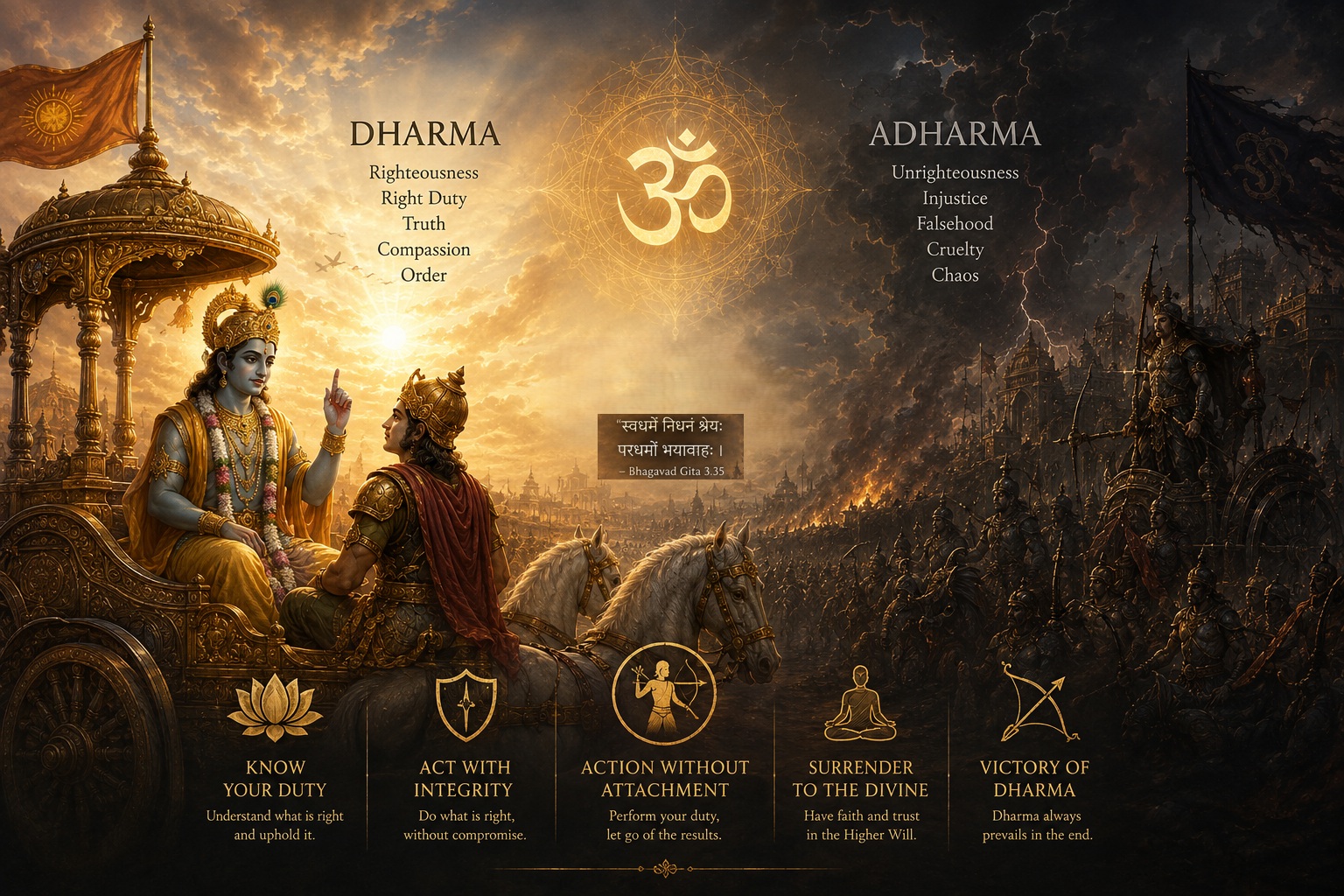
स्वधर्मे निधनं श्रेयः परधर्मो भयावहः —
It is better to live—and even die—fulfilling one’s own dharma than to follow the dharma of another.
This is Bhagavad Gita 3.35.